%2008.07.36_4ffe9739.jpg)




As organisations navigate economic pressure, talent shortages, and evolving work models, stress in the workplace statistics reveal how sustained strain affects productivity, retention, and long-term resilience. This 2026 guide brings together the latest workplace stress statistics worldwide, helping HR leaders and decision-makers understand where stress is rising, who is most affected, and how evidence-based interventions reduce risk.

Global Workplace Stress Statistics at a Glance
Global workplace stress statistics help HR leaders separate “noise” from systemic risk. This snapshot focuses on indicators that reliably track chronic workplace stress, job strain, and downstream outcomes like absenteeism, presenteeism, and productivity loss.
You can learn more about employee assistance program statistics in our specialized blog.
Workplace Stress Statistics by Region
Stress at work statistics vary significantly by region due to differences in labour laws, work hours, economic stability, and access to mental health resources. That's why understanding these patterns helps HR teams design locally relevant stress reduction programs rather than relying on one-size-fits-all solutions.
UK Workplace Stress Statistics
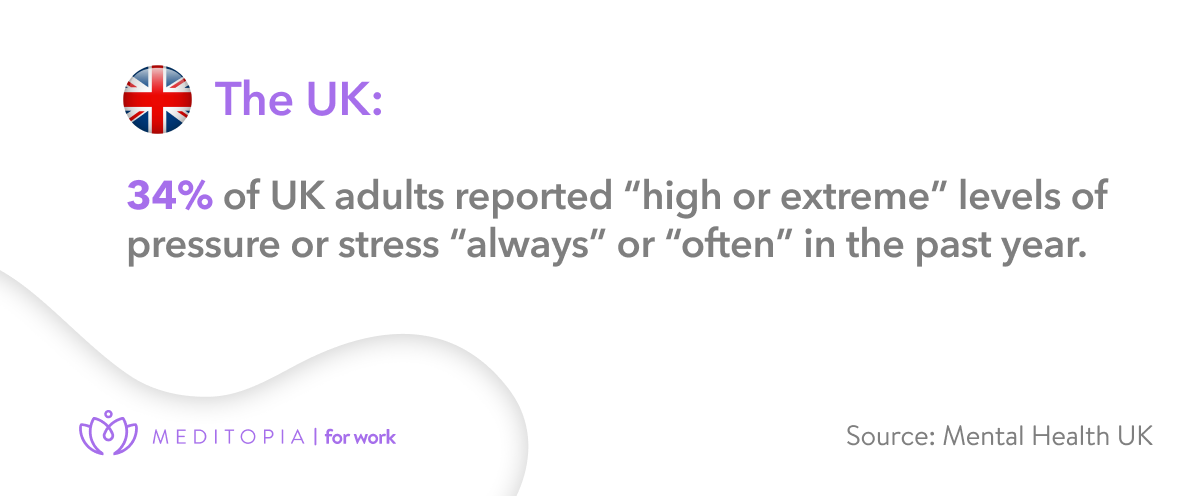
The UK reports some of the most consistently documented stress at work statistics, with stress remaining the leading cause of work-related ill health year after year [1].
- 964,000 workers were suffering from work-related stress, depression, or anxiety.
- Work-related ill health and injuries led to 40.1 million working days lost (2024/25), and stress-related conditions are a major contributor.
- Stress, depression, and anxiety cases show higher average days off per case (22.9 days) than injuries (6.5 days), meaning stress-related absence tends to be longer and harder to backfill.
- Working days lost due to stress, depression or anxiety were reported at 22.1 million (Great Britain, 2024/25).
Europe Workplace Stress Statistics
Across Europe, work related stress statistics show strong links between stress, job control, and psychosocial risk exposure, particularly in knowledge and service sectors [2].
- Over 50% of European workers report stress as common in their job.
- Psychosocial risks are among the fastest-growing workplace hazards.
- High job demands combined with low autonomy drive job strain.
- Stress strongly correlates with early labour market exit and long-term sickness absence.
- Northern and Western Europe report higher awareness but similar prevalence.
.png)
Canada & US Workplace Stress Statistics
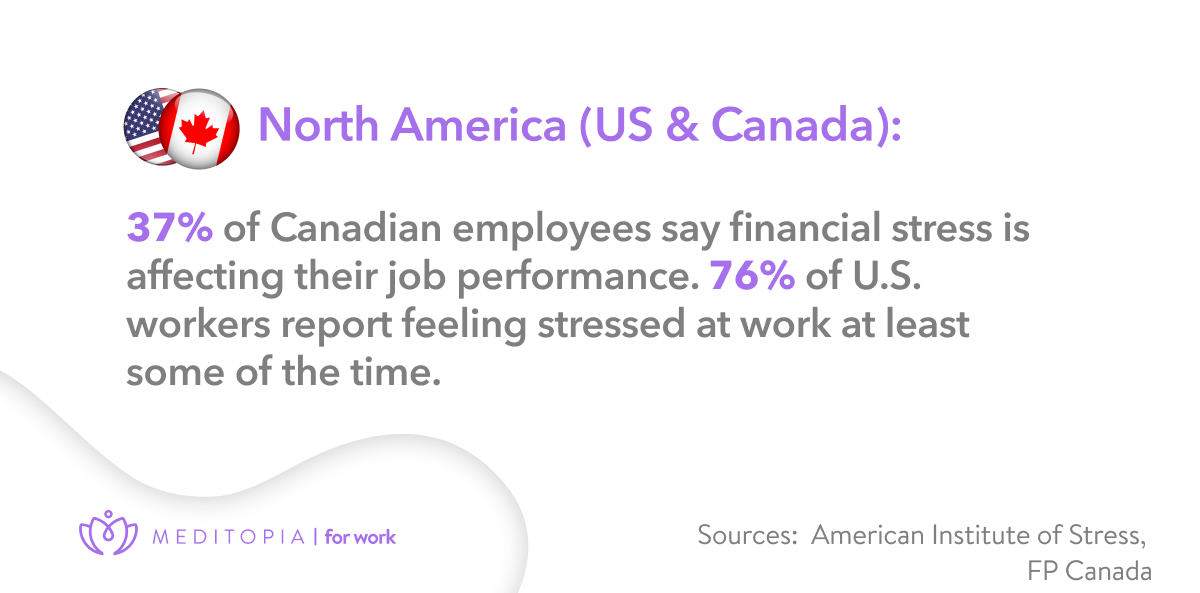
North America consistently reports high workplace stress statistics, particularly tied to workload intensity, job insecurity, and limited recovery time [3].
- In the United States, around 40% of employees report feeling stressed during much of the workday, placing the country among the higher-stress labour markets globally.
- In Canada, national surveys show that work stress is one of the top reported sources of day-to-day stress, particularly among full-time workers and managers
- US workers report higher levels of stress linked to workload intensity, job insecurity, and long hours.
- Canadian workers more frequently cite workload pressure, role overload, and work–life balance challenges as key stressors [4].
- In both countries, stress is strongly associated with presenteeism, reduced engagement, and higher burnout risk rather than short-term absenteeism alone.
Asia & Australia Workplace Stress Statistics
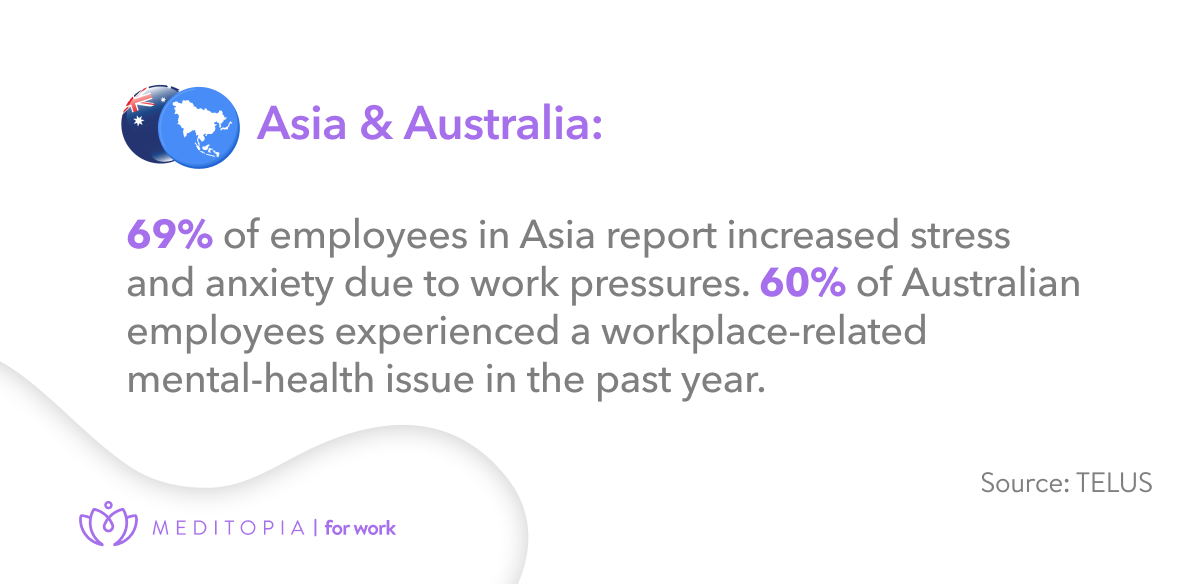
Workplace stress statistics across Asia–Pacific reflect a mix of long working hours, rapid digitalisation, and uneven access to mental health resources, with clear differences between Asian economies and Australia’s more regulated labour market.
- In Japan, government surveys show that over 50% of workers report strong anxiety, worries, or stress related to work, most commonly linked to workload, long hours, and interpersonal relations [5].
- In South Korea, long working hours remain a major stress factor; national labour statistics associate extended hours with higher levels of job strain and mental health risk, particularly among full-time employees [6].
- In China, work pressure and excessive workload are frequently cited stressors among urban employees, especially in technology and service sectors [7].
- In Australia, work-related stress is one of the leading causes of accepted workers’ compensation claims for mental injury, with workload pressure and poor organisational support cited as primary drivers [8].
- Australian psychosocial risk data also shows stress-related claims involve longer absence durations than physical injury claims, increasing workforce capacity risk.
Workplace Stress by Role, Industry & Demographics
You guessed right, stress looks and feels differently depending on many things. Differences in decision authority, emotional labour, workload intensity, and job security shape how stress in the workplace statistics appear across roles, industries, and employee groups.
By Role
- Managers and people leaders report higher stress levels than individual contributors, driven by decision pressure, people responsibility, and role ambiguity
- Frontline employees experience higher stress linked to workload intensity, shift patterns, and customer-facing demands
- Individual contributors in high-output roles face stress tied to performance metrics and constant time pressure
What this means for HR: Stress prevention needs role-specific interventions, leadership support for managers and workload predictability for frontline roles.
By Industry
- Healthcare and social care show the highest stress prevalence, linked to emotional demands, staffing shortages, and long shifts
- Education reports elevated stress due to workload volume, time pressure, and administrative burden
- Retail and hospitality face stress from unpredictable schedules, customer interaction, and low job control
- Technology and finance show high levels of job strain, driven by performance pressure, long hours, and rapid change
What this means for HR: Sector context matters, stress drivers in healthcare differ fundamentally from those in tech or retail, requiring tailored policies.
By Demographics
- Younger employees report higher emotional exhaustion, often linked to job insecurity, career uncertainty, and workload expectations
- Women consistently report higher stress levels, associated with workload, role ambiguity, and work–life conflict
- Lower-control roles show higher chronic workplace stress than roles with greater autonomy and flexibility
What this means for HR: Demographic patterns help identify where structural changes (control, flexibility, clarity) will reduce stress more effectively than individual resilience programs.
Main Causes of Work-Related Stress (Statistics)
So far, we know global consistently point to a small set of structural causes rooted in work design, management practices, and economic pressure, not exactly individual resilience gaps. Here's the data:
- Excessive workload:
- Over 41% of employees cite workload as a primary source of work stress, particularly where deadlines and staffing levels are misaligned [9].
- Over 41% of employees cite workload as a primary source of work stress, particularly where deadlines and staffing levels are misaligned [9].
- Long working hours:
- Working 55+ hours per week is associated with significantly higher stress and health risk [10].
- Working 55+ hours per week is associated with significantly higher stress and health risk [10].
- Poor management and low support:
- Employees with low managerial support are substantially more likely to report emotional exhaustion [11].
- Employees with low managerial support are substantially more likely to report emotional exhaustion [11].
- Job insecurity and organisational change:
- Workers experiencing job insecurity report higher stress and anxiety levels than those in stable roles [12].
- Workers experiencing job insecurity report higher stress and anxiety levels than those in stable roles [12].
- Lack of role clarity and control:
- Low autonomy and unclear expectations are strongly associated with job strain.
- Low autonomy and unclear expectations are strongly associated with job strain.
- Cost-of-living pressure:
- Financial stress increasingly spills into work-related stress, affecting focus and wellbeing.
The Impact of Stress (Statistics)
The data show that stress has measurable consequences for business performance, workforce stability, and healthcare costs, many of which remain invisible without targeted tracking. Here are some:
- Productivity loss:
- Depression and anxiety lead to an estimated 12 billion lost working days globally each year, costing around US$1 trillion in lost productivity [13].
- Depression and anxiety lead to an estimated 12 billion lost working days globally each year, costing around US$1 trillion in lost productivity [13].
- Absenteeism:
- Stress-related conditions account for a large share of long-term sickness absence in multiple labour markets.
- Stress-related conditions account for a large share of long-term sickness absence in multiple labour markets.
- Presenteeism:
- Employees experiencing high stress are more likely to be at work but operating below capacity, often costing employers more than absenteeism.
- Engagement loss:
- High stress is strongly associated with lower engagement and discretionary effort.
- Burnout risk:
- Prolonged exposure to stressors such as excessive workload and low control increases burnout risk [14].
- Healthcare and disability costs:
- Stress-related mental health conditions contribute to rising healthcare utilisation and disability claims [15].
- Stress-related mental health conditions contribute to rising healthcare utilisation and disability claims [15].
How Employee Wellness Programs & EAPs Reduce Workplace Stress
Data consistently shows that access to wellbeing resources, digital wellness tools, and structured stress reduction programs like the ones Meditopia offers, lowers reported stress levels and improves resilience.