



In 2026, the conversation has shifted from perks to preventative wellbeing. The question is no longer whether to run an employee wellness month, but how to make it meaningful, measurable, and aligned with business goals. Keep reading to discover how to do exactly that.

What Is Employee Wellness Month and Why It Matters
An employee wellness month (also referred to as employee wellbeing month or employee health and wellness month) is a dedicated period when organisations focus on wellbeing awareness, prevention, and engagement initiatives across physical, mental, and social health.
According to the World Health Organization, depression and anxiety cost the global economy an estimated US$1 trillion per year in lost productivity [1]. That's one of the reasons why, globally, workplace awareness campaigns have grown alongside increased attention to mental health at work.
Essentially, awareness months exist to:
- Educate employees about available support
- Normalize conversations about stress and mental health
- Encourage preventative wellbeing rather than reactive crisis management
- Re-activate underused employee health initiatives
When Is Employee Wellness Month?
There is no single global standard for employee wellness month. Common timings include:
- June – often aligned with Mental Health Awareness Month (US, UK and others)
- October – connected to World Mental Health Day (October 1)
- Custom dates aligned to fiscal cycles or internal strategy
Since strategic timing increases participation and relevance, HR teams and managers should align employee wellbeing month with:
- Known stress peaks (year-end targets, performance cycles)
- Budget planning windows
- Engagement survey timelines
- Existing awareness campaigns in the wellbeing calendar
Why Employee Wellness Months Often Fail (And How to Avoid It)
Good intentions aren't enough, and visibility alone does not create impact. Research consistently shows that awareness campaigns without structural support rarely improve mental health at work in a measurable way [2]. Here are the most common reasons employee wellness month initiatives fail, and how HR leaders can avoid them.
1. One-Off Activities Without Structural Change
Hosting a webinar or offering a single yoga session may increase short-term participation, but sustainable wellbeing requires systemic support.
The World Health Organization emphasizes that workplace mental health interventions are most effective when they address organizational risk factors, not just individual coping strategies [3]. If workload, unrealistic deadlines, or unclear expectations remain unchanged, awareness efforts lose credibility.
How to avoid it:
- Pair events with policy review (e.g., workload audits, meeting hygiene).
- Ensure managers receive training alongside employees.
- Link activities to long-term employee health initiatives.
2. Low Utilization of Existing Wellbeing Benefits
Many organizations already offer support but employees often do not use it. Employee Assistance Program (EAP) utilization rates historically average between 3% and 8% in many organizations [4]. Low awareness, stigma, or lack of trust frequently explain the gap. But also the lack of mobile content, gamification features, and personalized programs.
Moreover, an employee wellness month that simply adds more activities without improving awareness or psychological safety will not increase utilization meaningfully.
How to avoid it:
- Use the month to clearly explain what support exists.
- Address confidentiality concerns transparently.
- Normalize usage through leadership endorsement.
3. Lack of Leadership Involvement
Employees take behavioral cues from leadership. Gallup’s research shows that managers account for at least 70% of the variance in team engagement [5]. If leaders do not visibly participate in employee wellbeing month (or if workloads contradict the message) employees may perceive the initiative as performative.
How to avoid it:
- Encourage executives to speak openly about stress and boundaries.
- Provide managers with structured conversation guides.
- Adjust workload expectations during the month where possible.
4. Over-Reliance on Perks Instead of Preventative Wellbeing
Free snacks, fitness challenges, or branded merchandise can generate short-term enthusiasmm but they rarely address root causes of stress or burnout.
The APA Work and Well-Being Survey highlights that employees consistently rank workload, staffing levels, and organizational culture as primary stressors, not lack of perks [6]. Essentially, if employee wellness month focuses only on surface-level activities, it risks becoming symbolic.
How to avoid it:
- Incorporate education around stress physiology, sleep, and boundaries.
- Include professional mental health access.
- Align initiatives with long-term holistic wellbeing strategy.
5. Wellbeing Washing
Wellbeing washing occurs when organizations communicate care without embedding wellbeing into culture, leadership behaviors, and systems. According to Deloitte, trust in organizational wellbeing efforts declines when messaging is not matched by action [7]. An employee health and wellness month that is heavy on messaging but light on structural change can unintentionally damage trust.
How to avoid it:
- Communicate clearly what is changing, not just what is being offered.
- Share data transparently (participation, feedback themes).
- Commit to year-round action beyond the awareness campaign.
How HR Can Plan a High-Impact Employee Wellness Month
A high-impact employee wellness month is a coordinated intervention within your broader employee health initiatives and wellbeing calendar. Moreover, research consistently shows that effective workplace wellbeing programs share three characteristics:
- Leadership alignment
- Data-informed design
- Astructural follow-through
Below is a strategic framework HR leaders can use to design a meaningful and measurable employee wellness month.
1. Start With a Risk Assessment, Not a Theme
The WHO emphasizes that reducing workplace risk factors (excessive workload, low autonomy, role ambiguity) is more impactful than individual-only interventions. Conduct a rapid diagnostic:
- Pulse survey on stress drivers
- Absenteeism and turnover patterns
- Exit interview themes
- Engagement survey data
- EAP utilization rates
If workload pressure is the top issue, meditation sessions alone will not solve it. The month must address root causes.
2. Define Clear, Measurable Objectives
Avoid vague goals such as “raise awareness.” Instead, define 2–3 measurable objectives, such as:
- Increase EAP utilization by X%
- Improve manager participation rate
- Raise awareness of mental health support (measured via post-campaign survey)
- Improve psychological safety scores
Clarity of expectations and manager engagement strongly influence overall team wellbeing and performance. Tie your employee wellness month objectives to engagement and retention KPIs where possible.
3. Align Leadership Early
Wellbeing initiatives fail when leaders are informed late. Before launch:
- Brief executives on the purpose and business case
- Provide leaders with talking points
- Encourage leaders to model participation
- Ask managers to schedule check-ins during the month
Visible leadership involvement increases psychological safety and reduces stigma.
4. Design a Balanced Intervention Portfolio
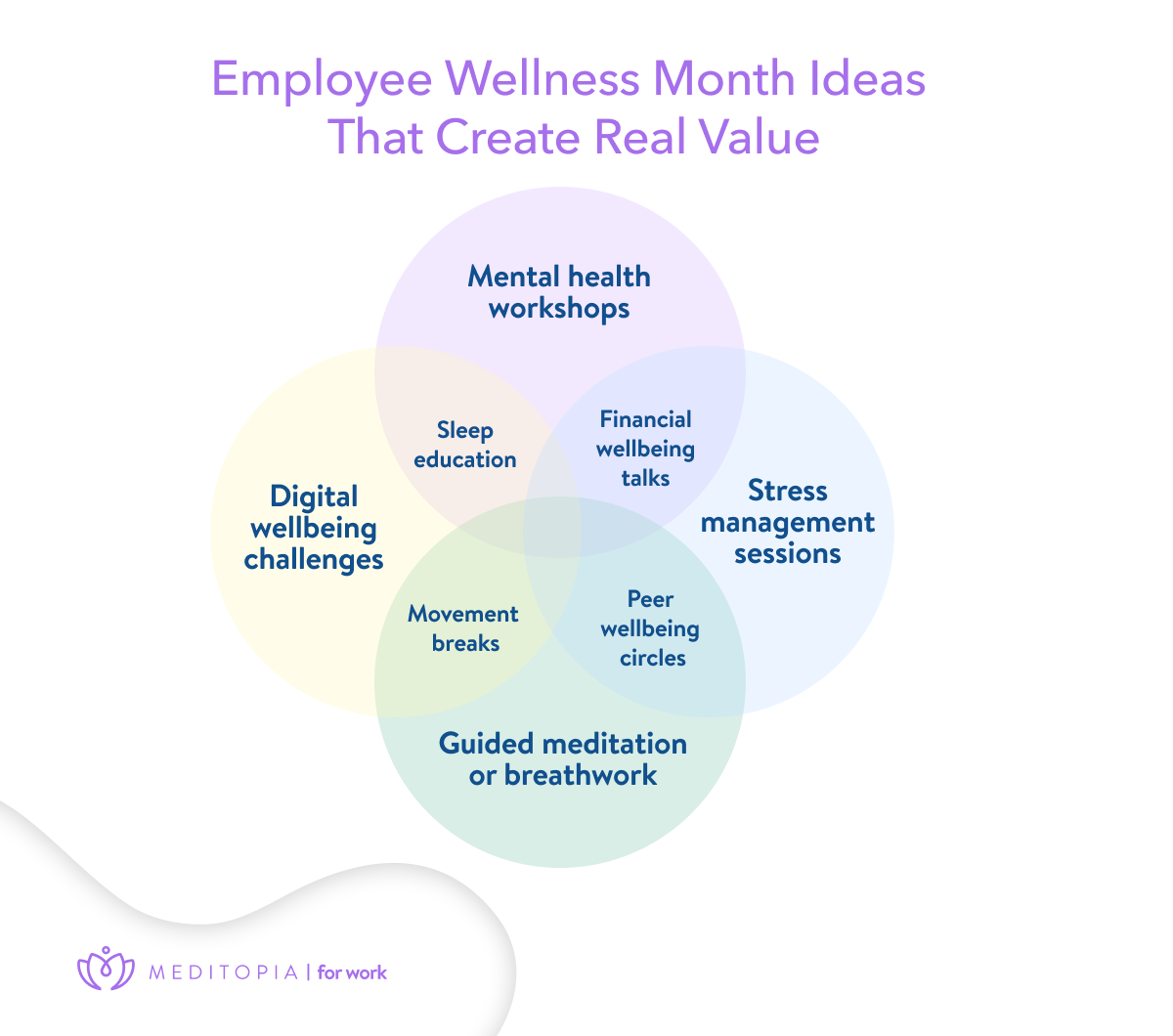
Employees consistently identify workload and lack of support as major stressors [8]. Therefore, a mix of structural + educational + supportive elements creates credibility. Consider these dimentions to address real holistic wellbeing at work:
a) Structural Actions
- Meeting-free blocks
- Workload redistribution reviews
- Manager training on burnout prevention
b) Professional Support
- Access to licensed therapists or coaches
- Financial wellbeing seminars
- Sleep and stress education workshops
c) Preventative Wellbeing
- Guided meditation or breathwork
- Movement challenges
- Digital self-guided resources
5. Make It Accessible and Inclusive
Not all employees can attend live sessions during business hours, especially employees from delicate industries like construction, healthcare, and military. Since the The OECD highlights that inclusive workplace practices contribute to improved wellbeing and productivity outcomes [9], ensure:
- Hybrid participation options
- On-demand recordings
- Shift-worker access
- Multilingual materials where relevant
- Neurodiversity-friendly formats
6. Address Stigma Directly
The WHO reports that stigma and discrimination continue to prevent employees from seeking help, even when services exist. So, during employee wellness month:
- Communicate confidentiality clearly
- Share anonymized usage data if possible
- Include leadership testimonials
- Normalize help-seeking behavior
7. Integrate the Month Into Your Broader Wellbeing Calendar
Employee wellness month should not sit in isolation. Instead:
- Link it to upcoming awareness campaigns
- Announce year-round wellbeing plans
- Introduce future manager training sessions
- Share roadmap milestones
This prevents “campaign fatigue” and reduces the risk of wellbeing washing.
8. Measure What Matters
Without evaluation, impact remains anecdotal. Consider tracking:
- Participation rates
- Utilization of mental health services
- Feedback surveys
- Manager engagement metrics
- Post-month wellbeing pulse scores
Moreover, the WHO guidelines emphasize ongoing monitoring and evaluation as critical components of workplace mental health strategy. Post-campaign reflection questions:
- What barriers limited participation?
- What activities drove meaningful engagement?
- What structural adjustments are required next?
9. Communicate With Precision — Not Overload
Avoid overwhelming employees with excessive messaging. Effective employee wellbeing month communication:
- Explains why the initiative matters
- Highlights practical value
- Provides clear signposting to resources
- Reinforces leadership commitment
35 Employee Wellness Month Ideas (Activities That Create Real Value)
Below are inclusive and evidence-aligned activities HR teams can implement during employee wellness month. You do not need to plan all of these activities together. Check them out, choose some that fit your organizational needs, and update.
🔹Structural & System-Level Interventions (High Impact)
- Meeting Reset Week: Audit recurring meetings. Cancel, shorten, or convert unnecessary ones to async formats.
- No-Meeting Focus Blocks: Introduce protected focus hours organization-wide for one week.
- Workload Transparency Workshop: Managers map team workload and identify bottlenecks in real time.
- Manager Burnout Prevention Training: Train leaders to spot early burnout indicators and intervene constructively.
- Psychological Safety Roundtables: Facilitated discussions where teams define what “safe to speak up” means locally.
- Role Clarity Sprint: Short workshops clarifying expectations, deliverables, and decision authority.
- Boundary-Setting Campaign: Provide templates for “decline scripts” and healthy availability norms.
- Digital Hygiene Policy Review: Revisit after-hours email expectations and notification norms.
🔹 Mental Health & Emotional Wellbeing
- Licensed Therapist Office Hours: Offer bookable 20-minute confidential Q&A sessions.
- Stress Physiology Masterclass: Explain how stress works biologically and how to regulate it.
- Cognitive Load Workshop: Teach prioritization and decision-fatigue management techniques.
- Micro-Recovery Training: Teach 3–5 minute recovery resets employees can use between tasks.
- Resilience Myth-Busting Session: Discuss why resilience is not “toughing it out.”
- Emotional Agility Training: Based on evidence-backed emotional regulation frameworks.
- Grief & Life Events Support Session: Address often-ignored emotional realities at work.
🔹 Preventative Wellbeing & Self-Guided Support
- Guided Meditation Series (Themed Week): Daily 10-minute sessions tied to focus, calm, or sleep.
- Breathwork for High-Pressure Roles: Tailored sessions for sales, customer-facing, or leadership teams.
- Sleep Reset Challenge: Track sleep habits and provide educational content on circadian rhythms.
- Digital Wellbeing Detox Day: Encourage mindful technology breaks.
- Focus & Deep Work Sprint: Team-based challenge to complete one meaningful task distraction-free.
🔹 Physical & Energy Wellbeing
- Movement Micro-Break Protocol: 3 daily guided stretch breaks for remote and onsite employees.
- Posture & Ergonomics Assessment Clinics: Virtual or in-person workstation reviews.
- Energy Management Workshop: Shift conversation from time management to energy cycles.
- Walking Meetings Initiative: Encourage small meetings outdoors or standing.
- Hydration & Nutrition Awareness Campaign: Evidence-based tips, not diet culture messaging.
🔹 Financial & Practical Wellbeing
- Financial Stress Management Seminar: Address budgeting, debt stress, and financial planning basics.
- Benefits Literacy Workshop: Explain how to use existing support systems clearly.
- Healthcare Navigation Q&A: Help employees understand medical benefits access.
🔹 Social & Cultural Wellbeing
- Peer Wellbeing Circles: Small facilitated discussion groups.
- Cross-Team Connection Sessions: Low-pressure structured networking to reduce isolation.
- Recognition Reset Campaign: Encourage meaningful peer-to-peer recognition.
- Values Reflection Workshop: Reconnect daily work to personal values and purpose.
🔹 Leadership-Specific Actions
- Executive Vulnerability Talk: Senior leaders share personal wellbeing practices or challenges.
- Manager 1:1 Wellbeing Check-In Toolkit: Structured conversation guide for managers.
- Leadership Listening Tour: Executives hold small-group listening sessions on stressors.
The Role of Leaders and Managers During Employee Wellbeing Month
Leaders determine whether employee wellness month feels safe or performative. Consider that employees watch for:
- Whether leaders speak openly about stress
- Whether managers encourage participation without pressure
- Whether workloads are adjusted during the month
Essentially, role modeling matters. Research consistently shows psychological safety improves when leaders demonstrate vulnerability and openness. So managers should: Check in proactively, share personal wellbeing practices, normalize boundaries, reinforce preventative wellbeing behaviors.
Using Employee Wellness Month to Strengthen Wellbeing Programs
Employee wellness month is an ideal moment to:
- Launch therapy access
- Promote self-guided wellbeing content
- Roll out manager training
- Introduce AI-based support tools
- Re-activate underused benefits
For example:
- If EAP usage is low, use the month to destigmatize it.
- If engagement initiatives are fragmented, consolidate them under one cohesive awareness campaign.
Instead of overwhelming employees with new tools, HR can stage a gradual rollout tied to a broader wellbeing calendar.
How Meditopia for Work Supports Employee Wellness Month (and Beyond)
Meditopia for Work enables HR teams to design meaningful employee wellness month initiatives while supporting year-round wellbeing.
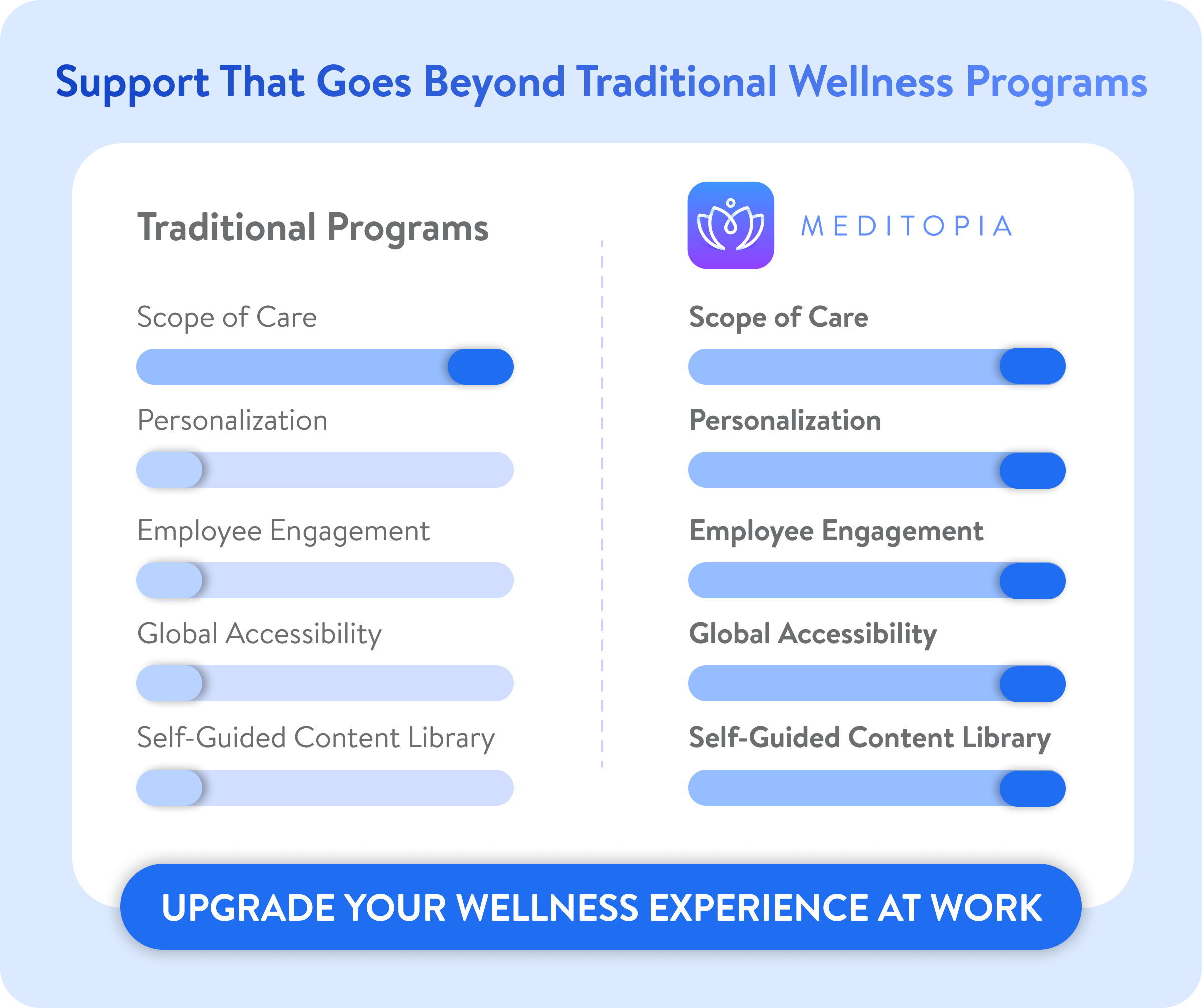
- 1:1 Expert Sessions:
Employees can access licensed psychologists, dietitians, coaches, and other specialists—ensuring mental health at work is backed by professionals. - SOUL AI for Everyday Emotional Support:
AI-powered guidance provides immediate emotional check-ins and support between sessions. - Self-Guided Content in 14 languages:
Thousands of evidence-based meditations, sleep programs, and stress-management tools support preventative wellbeing. - Online Trainings & Webinars:
HR teams can integrate structured workshops into their employee wellbeing month calendar.
What to Do After Employee Wellness Month (Sustaining Momentum)
The true impact of employee wellness month is measured after it ends. HR teams should:
- Measure participation and feedback
- Track utilisation of wellbeing programs
- Compare pre- and post-campaign engagement metrics
- Communicate “what happens next” clearly
- Integrate insights into long-term strategy
Last, but not least important: Talk to your team! Check their thoughts, ideas, and opinions.