



In 2026, AI anxiety is rarely “anti-AI.” More often, it’s a rational response to uncertainty, role-specific impact, and change happening faster than people can metabolize. If you’re in HR or a leadership role, your goal is to reduce ambiguity, protect psychological safety, and help teams build capability. Let's discover more about AI anxiety and what can organizations do about it.

What Is AI Anxiety?
AI anxiety is the worry, stress, or dread employees experience when AI tools (or AI-driven decisions) threaten their sense of stability at work, often tied to fears like job displacement, skill obsolescence, loss of autonomy, and unclear expectations.
AI anxiety vs. general tech anxiety
- General tech anxiety is usually about learning a new system or fear of “breaking something.”
- AI anxiety is more existential and social: “Will my role still matter?” “Will I be judged if I use AI?” “Will AI make decisions about me?” It also tends to be role-specific, because AI exposure and automatable tasks vary widely by job family.
The emotional drivers behind AI-induced anxiety
- Job displacement fear: concern that automation replaces tasks, then roles.
- Skill gap + obsolescence: worry that current strengths won’t be valued.
- Loss of autonomy: fear of being micromanaged by systems, prompts, or metrics.
- Evaluation anxiety: uncertainty about how performance will be measured in an AI-enabled workflow (and whether AI use is “allowed” or stigmatized).
AI Anxiety Research & What the Data Shows
AI anxiety is not exactly niche. Multiple large surveys show meaningful levels of worry and overwhelm tied to AI’s future impact at work, here are some of the most important ones:
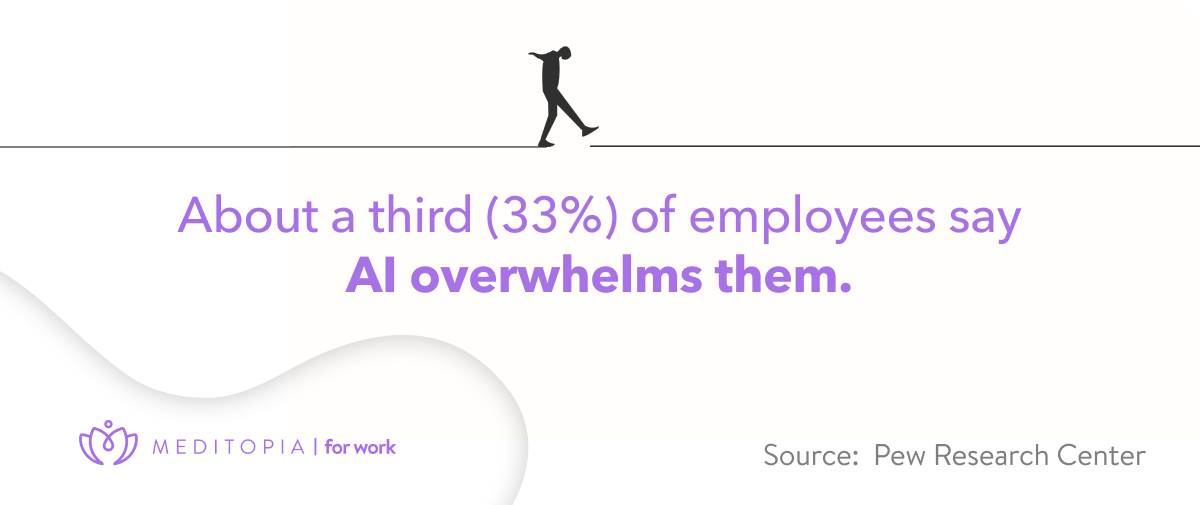
- 52% of U.S. workers say they’re worried about the future impact of AI use in the workplace; 33% say they feel overwhelmed [1].
- In the same research, 32% think AI will lead to fewer job opportunities for them long-term.
- Public perception is also stark: a Gallup study found 75% of Americans believe AI will lead to fewer job opportunities over the next decade [2].
- Employees often use AI faster than organizations expect, while leaders underestimate how much it’s already shaping workflows, creating a governance and trust gap [3].
- “Quiet” or hidden usage is real: a large global study eported 57% of employees admit to hiding their AI use at work, often a sign of fear, unclear policy, or stigma [4].
- In the UK specifically, 27% of workers fear their job could disappear due to AI within five years, and nearly half believe AI benefits employers more than employees [5].
- Across Europe, a survey found that 42% of employees fear AI could put their job at risk, and in Switzerland 43% are concerned about AI’s effect on their own job [6].
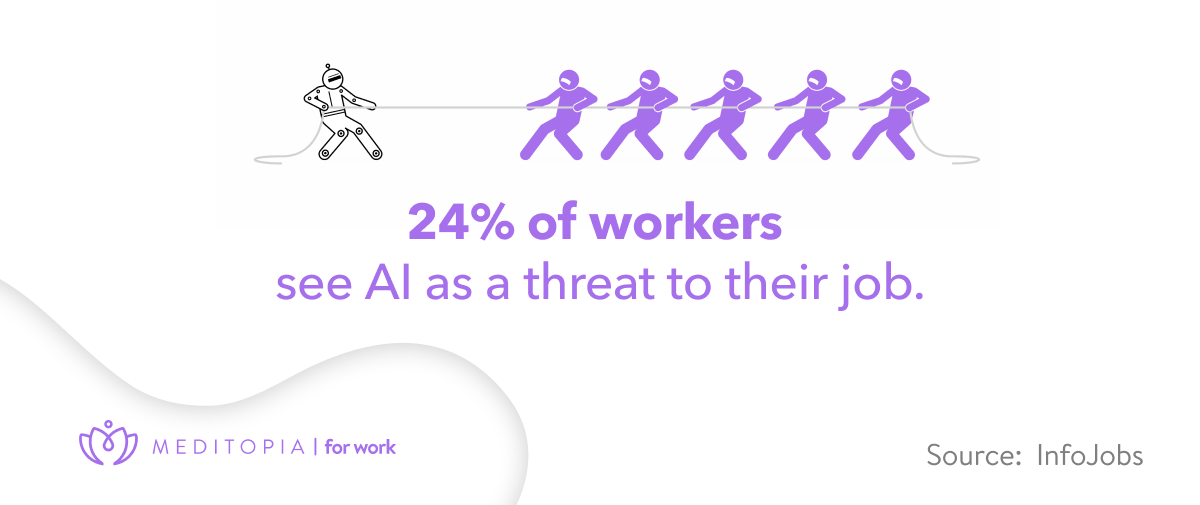
- In Spain, a survey reported that around 24% of workers see AI as a threat to their position, though that concern appears to be declining as familiarity rises [7].
- In Mexico, about 37% of professionals reported using AI weekly, but a significant portion still felt companies weren’t preparing them adequately and expressed worry about being replaced [8].
- In Southeast Asia, 35.3% of workers cite job security as their top concern about AI, especially in the Philippines (43.8%) and Cambodia (40.6%) [9].
- In China, many employees see positive potential in AI, but concerns around job displacement and uncertainty persist, and those who believe they could be replaced are more likely to seek new jobs, indicating anxiety influencing behavior and retention dynamics [10].
Signs of AI-Induced Anxiety in Employees
AI anxiety doesn’t always look like panic, it often shows up as subtle behavior shifts. Here are some things you should pay attention to as a manager or leader:
Early signals (What managers can actually observe)
- Reduced confidence: “I’m not technical enough,” “I can’t keep up.”
- Loss of motivation: less initiative, less curiosity, more disengagement.
- Resistance to AI tools: dismissive comments, refusal to try, “we don’t need this.”
- Avoidance of training: skipping sessions, “too busy,” not completing pilots.
- Overchecking / perfectionism: unusually high fear of mistakes, constant rework.
- Quiet resistance: complying publicly while ignoring tools privately (or using them secretly).
Performance-Level Signals (Operational impact)
- Reduced productivity despite available AI tools
- Overreliance on manual processes
- Poor AI adoption or superficial usage
- Mistakes caused by stress, not lack of skill
- Slower decision-making due to fear of being wrong
- Innovation freeze (less experimentation)
Social & Cultural Signals (Team-level)
- Rumor cycles about layoffs or automation
- “Us vs. leadership” narratives
- Cynicism toward digital transformation initiatives
- Reduced psychological safety in meetings
- Increased conflict between “AI enthusiasts” and “AI skeptics”
- Stigma around using AI (“cheating” or “lazy” framing)
Common Causes of Anxiety About AI at Work
In most organizations, AI anxiety grows from predictable conditions, not personality.
- Lack of communication → rumor-driven narratives fill the vacuum.
- No clarity on job impact → employees imagine worst-case scenarios.
- Skill gap fear → “AI adoption” feels like a moving target without a map.
- Poor training → generic “AI literacy” without role-specific workflows.
- Top-down decisions → no employee voice in pilots or tool selection.
- Evaluation ambiguity → “Is it cheating if I use AI?” “Will I be punished for errors?”
- FOMO + status anxiety → fear of falling behind peers who “get AI” faster.
The Impact of AI Anxiety on Performance, Engagement & Retention
Unchecked AI anxiety becomes an operational risk because it changes behavior at scale. What it can do to teams:
- Reduced AI adoption: people avoid tools or use them superficially, limiting ROI.
- Productivity loss: time wasted on worry, rumor cycles, rework, or tool switching.
- Change fatigue: constant learning pressure without stability creates burnout risk.
- Lower trust in leadership: “They’re not telling us the full story.”
- Higher attrition risk: especially in roles that feel “most exposed,” or where career pathways look unclear.
Moreover, research shows that when employees feel threatened by automation and AI, this perception doesn’t simply “feel bad,” it is statistically connected to work outcomes through elevated stress and lowered wellbeing:
- A study found that higher awareness of AI/automation replacing workers predicted increased job stress and lower affective wellbeing at work, which is a known precursor to disengagement and performance decline [11].
- Quantitative analyses reveal that AI exposure correlates with increased job insecurity, anxiety, and burnout, along with reduced morale [12].
- Predictive models from workplace mental health research estimate that, in high-risk scenarios including rapid technological change, up to 81% of workers could show anxiety signals if stressors aren’t mitigated [13].
- Broader literature on technostress demonstrates that stress from technological disruption can decrease job performance and satisfaction, a pattern that aligns with what we observe when AI adoption isn’t paired with human-centered support [14].
How to Manage AI Anxiety at Work (What HR & Leaders Can Do)
Below are prevention strategies that work best when combined (not done as one-off announcements).
1) Communicate early & transparently (and keep repeating)
- Share what’s known, what’s unknown, and when updates will come.
- Name tradeoffs honestly (speed vs. safety, experimentation vs. stability).
- Create a single “source of truth” hub: policy, approved tools, safe-use rules, training paths.
Tip: Use plain language. If employees need to decode leadership comms, anxiety rises.
2) Focus on augmentation, not replacement (with role-specific examples)
Don’t say “AI won’t replace jobs” in a generic way. Instead:
- Show which tasks are changing and which human strengths become more valuable.
- Use before/after workflow demos by role (e.g., recruiter screening, analyst summarization, customer support triage).
Tip: Avoid hype. Overpromising triggers skepticism and “this is a hidden downsizing” interpretations.
3) Invest in skill-building that feels achievable
Move from broad AI literacy to role-specific enablement:
- “AI for Customer Support: deflection vs escalation, tone safety, knowledge base prompts”
- “AI for Managers: coaching scripts, performance conversations, decision logs”
- “AI for HR: policy, fairness checks, communications, change design”
Tip: A short, structured pathway beats an infinite library.
4) Create psychological safety guardrails
- Normalize learning curves (“experiments will be messy”).
- Allow questions without penalty; reward raising risks early.
- Establish “human in the loop” standards for sensitive decisions.
Tip: Add AI learning goals to performance conversations, explicitly protect time for experimentation, and publicly model mistakes at the leadership level.
5) Reduce FOMO with clear rules and equitable access
- Define which tools are approved and why.
- Provide equal access, not “whoever finds a workaround.”
- Make “safe use” and “data boundaries” explicit (to reduce fear of accidental misconduct).
Tip: Publish a simple, living AI playbook (approved tools, data limits, review requirements) and update it visibly.
How HR Can Build a Human-Centered AI Adoption Strategy
Think of AI adoption like any major change program: beliefs, behavior, capability, and trust.
A practical change-management framing:
- Sensemaking: What is AI doing here, and why now?
- Role clarity: What changes in my work (role-specific), what doesn’t?
- Capability: What do I need to learn next (and what support do I get)?
- Safety: Can I ask questions, make mistakes, and report issues?
- Feedback loops: How does my input shape the rollout?
Employee involvement in pilots (non-negotiable):
- Include frontline and junior employees in pilot design, not only “AI champions.”
- Run pilots by job family; document edge cases.
- Publish what changed because of employee feedback.
Psychological safety as a KPI:
Alongside adoption, track:
- “I feel safe asking questions about AI”
- “I understand how AI affects my role”
- “I trust leadership to use AI responsibly”
- “Training feels relevant to my day-to-day work”
How Meditopia for Work Supports Employees Facing AI Anxiety
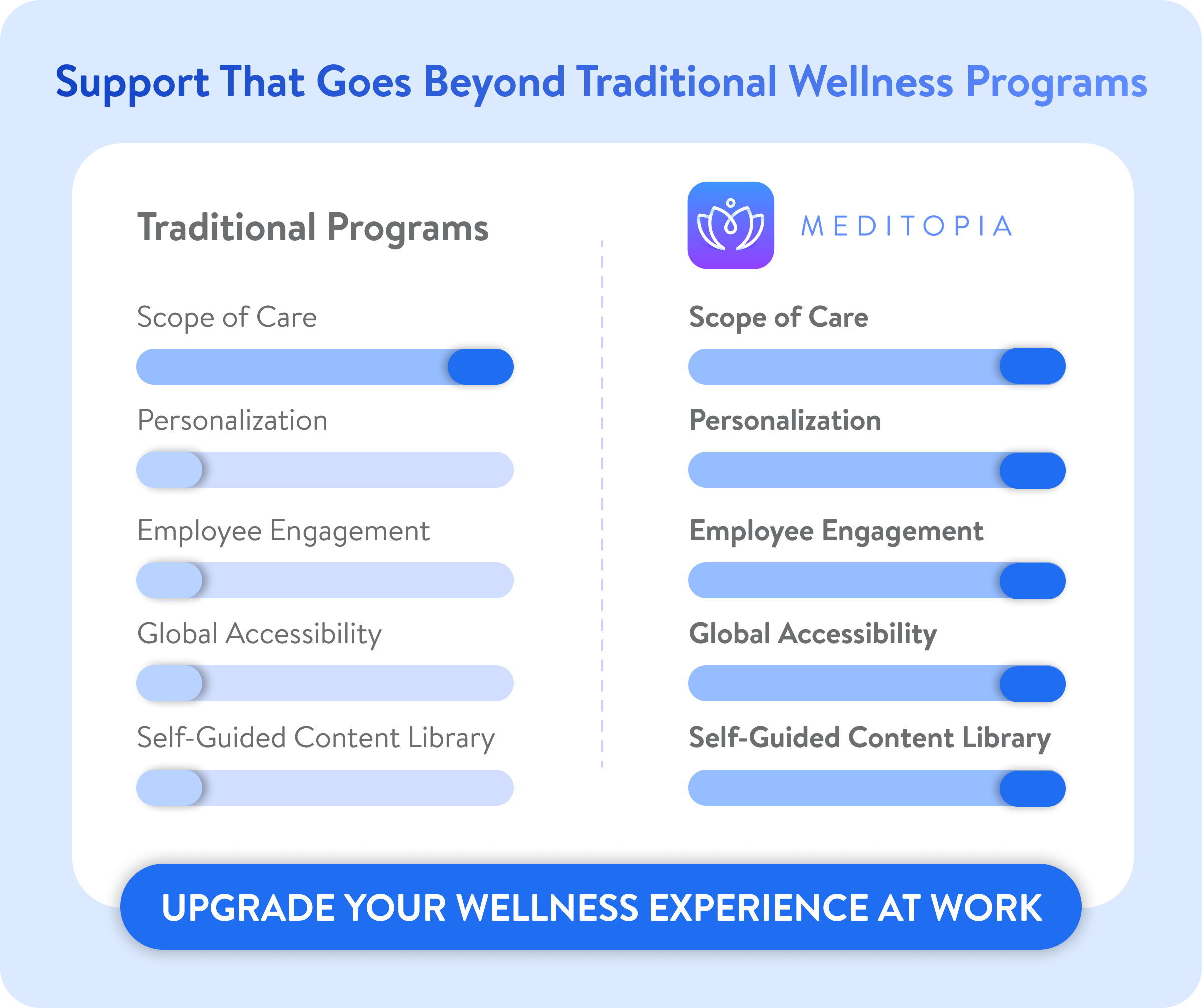
A human-centered AI strategy needs training, ongoing emotional support, skill-building, and psychological safety. Here’s how Meditopia for Work can support employees experiencing AI anxiety:
1) 1-1 Expert Sessions (role and life context included)
Employees can speak with qualified experts about:
- Performance anxiety during AI transitions
- Uncertainty stress and change fatigue
- Confidence rebuilding and coping strategies (This is especially valuable when anxiety is personal, not just procedural)
2) SOUl AI for everyday emotional support
AI anxiety often spikes between meetings, when employees spiral privately. An always-available support layer like SOUL, an AI wellbeing companion trained by mental health experts, can help with:
- Reframing catastrophic thoughts (“I’ll be replaced” → “my tasks are changing; what’s my next step?”)
- Quick grounding when overwhelmed
- Planning “small wins” that rebuild control
3) Self-guided content for stress, sleep, and resilience
When transformation pressure rises, basics slip (sleep, recovery, emotional regulation). Preventive resources help reduce burnout risk and improve day-to-day stability.
4) Online trainings that match real workplace needs
Support can be designed around:
- Psychological safety habits for managers
- Change readiness
- Coping with uncertainty stress and transition anxiety
- Building healthier human–AI collaboration norms