



Studies suggest that 30–50% of healthcare professionals experience burnout at some point in their career [1], driven by long hours, emotional labour and high-risk environments. It not only compromises patients' safety, it also exposes healthcare workers to chronic mental and physical conditions if untended. Here's where EAPs for health care can change the game, let's discover how.

Why EAPs Matter in Healthcare
The pressures shaping mental health in healthcare are unlike those in most other industries. Staff regularly witness trauma and death, carry responsibility for life-or-death decisions, and often work in chronically understaffed environments.
Recent research highlights the scale of the problem:
- A systematic review found burnout prevalence among healthcare workers ranging up to 57.4% on average across studies [2].
- Moreover, a large survey of health workers showed poor mental health days rising from 3 to 5 days per month between 2018 and 2022, with burnout jumping from 32% to 46% [3].
- In one study of over 9,000 healthcare workers, 45.7% had a current mental disorder and 14.5% a disabling one, including major depression, anxiety disorders and PTSD [4].
- A recent global study reported 61% of nurses experiencing anxiety, depression or burnout, and 57% feeling exhausted every day at work [4].
It looks challenging, but well-designed EAP healthcare solutions give staff confidential access to employee counselling, psychological support and practical resources for stress management for healthcare employees.
Evidence also shows that employee assistance services can reduce absenteeism, workplace injury rates and health-related productivity loss, and improve mental health outcomes. Let's discover more.


EAP Use Cases in Healthcare
Abstract promises rarely shift behaviour. Concrete, relatable use cases help managers and staff understand exactly how an EAP for healthcare workers fits into their reality. Here you have some examples of digital EAP solutions and how they support employees in this industry:
Key Benefits of EAPs for Healthcare Companies
For healthcare organizations, EAPs sit at the intersection of workplace wellbeing, patient safety and financial sustainability. Still, research on employee assistance and workplace mental health suggests multiple benefits: reduced absenteeism and presenteeism, improved mental health, and better perceived productivity.
- Lower absenteeism & faster return-to-work: Programs of employee assistance showed users reduced sick hours 4.8 – 6.5% faster than non‐users [5].
- Reduced turnover and increased retention: Access to EAP services significantly predicted lower turnover intention and higher employee productivity [6].
- Improved patient safety & care quality: EAP counselling reduces burnout-related symptoms, and burnout is directly linked to reduced patient safety, EAPs indirectly support better clinical outcomes.
- Stronger employee engagement & wellbeing culture: Availability of Ethese wellness programs correlates with better thriving at work, lower stress and higher organisational commitment.
- Employer brand & readiness for change: Organisations implementing EAPs for burnout prevention in healthcare report improved employee retention and reduced healthcare-related costs, reinforcing a modern wellbeing-focused employer identity.
You can discover more EAP statistics in our specialized blogs.
How to Implement an EAP in a Healthcare Organization
Rolling out an EAP in a hospital or healthcare network is more complex than switching on a generic benefit. Since healthcare has unique operational patterns, unions, professional bodies and clinical hierarchies, a structured approach is needed.
1. Assess Wellbeing Needs and Risks: Start by mapping the reality of mental health support across your organization:
- Analyze absence data (e.g., mental-health-related sick days—some NHS data show hundreds of thousands of such days in a single month).
- Review incident reports relating to violence, aggression or traumatic events.
- Run anonymous surveys on stress, burnout and psychological safety, with specific questions on role (e.g., ICU, ED, primary care, community).
- Gather qualitative insights from occupational health, staff representatives and union partners.
This gives you a baseline to prioritize burnout prevention in healthcare, not just crisis response.
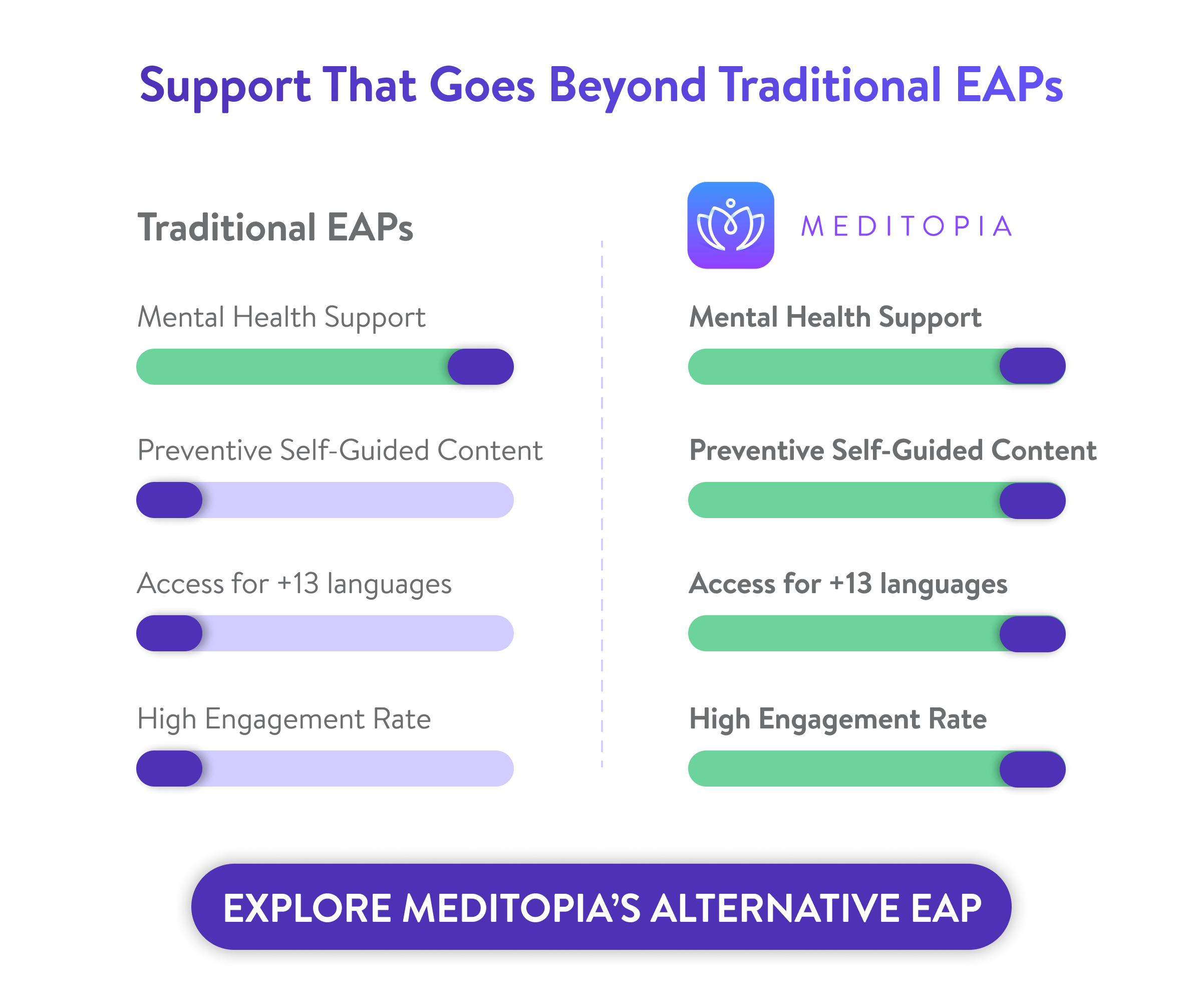
2. Choose the Right EAP Partner (Traditional vs Digital):
- Clinical relevance: Do counsellors understand healthcare contexts (shift work, moral injury, triage decisions, chronic understaffing)?
- Accessibility for shift workers: Can staff access support outside typical office hours, via multiple channels (phone, video, chat, app) without promising unrealistic 24/7 coverage?
- Scope of services: Beyond counselling, are there resources for financial stress, family issues, grief and chronic health management that also affect performance?
- Meditopia for Work is ready to support your healthcare employees in all these areas.
- Integration: Can the EAP integrate with your HRIS, learning systems and existing wellness initiatives as one coherent employee wellness tool?
- Data & reporting: Will HR receive anonymized insights on usage patterns, presenting issues and outcomes? Meditopia offers you access to your employer dashboard, to check real-time anonymous metrics, and personalized reports for preventive plans.
3. Design a Clear, Trust-Centred Communication Plan: Low utilization is one of the biggest barriers to EAP impact; some studies suggest only 3–5% of employees access their EAP even when they need help.
To change that in healthcare:
- Train managers and clinical leaders to talk about the EAP without judgement, integrating it into daily conversations about workplace wellbeing.
- Emphasise confidentiality clearly and repeatedly (how data is handled, who sees what).
- Tailor messaging by role: employee assistance program for nurses, physicians, allied health, admin, and students or residents may each need different examples.
- Align EAP communication with other employee engagement programs, wellness days and safety campaigns.
Meditopia for Work can take care of all those steps for you.
4. Embed the EAP in Everyday Processes: To move from “benefit on paper” to “tool people actually use”:
- Include theprogram's information in onboarding and return-to-work processes.
- Encourage occupational health and HR to refer staff to the EAP as part of broader care pathways.
- Link EAP and employee counselling services to manager training on stress, compassion fatigue and conflict.
This framing helps staff see the plan as part of core clinical risk management, not just an HR add-on.
5. Track Outcomes and Iterate:
- Monitor utilization by role and location (while preserving anonymity).
- Track indicators like mental-health-related absences, turnover in high-risk units, and self-reported wellbeing over time.
- Combine EAP analytics with staff survey data and patient safety metrics to understand the bigger picture.
- Adjust your strategy regularly: new workshops, targeted campaigns for specific units, or additional support after particularly intense periods (e.g., winter pressure, pandemics, large-scale incidents).
- If it sounds exhausting, trust Meditopia for Work! We can craft communications, challenges, your own social network for a stronger community feeling, and more. Just send us a message to discuss how we can support you, exactly.
Why EAPs Matter for Healthcare: Comparison With Other Industries
Most sectors are grappling with mental health at work, but the intensity and type of risk differ.
Construction and manufacturing, for example, might focus more on physical risk; tech companies wrestle with chronic overwork and screen fatigue; education and non-profits often face emotional labour and resource constraints.
Healthcare combines high emotional exposure, life-or-death responsibility and systemic pressures such as staffing shortages and aging populations. That’s why a tailored eap healthcare solution needs a stronger emphasis on trauma, grief, moral injury and professional identity, alongside more “generic” stress support.