

The demand for workplace wellbeing has never been higher, yet many organisations are falling into wellbeing washing (or wellness washing).This disconnect erodes trust, disengages staff, and weakens culture. In this guide, HR leaders will learn how to distinguish shallow wellness perks from systemic, evidence-based wellbeing initiatives aligned with employee needs and organisational success.

What Is Wellbeing Washing?
Wellbeing washing refers to practices that appear to prioritise employee wellbeing while failing to provide systemic, evidence-based support. Much like greenwashing, it emphasises image and marketing over addressing the real roots of stress, burnout, and workplace challenges.
Unlike authentic wellbeing strategies that prioritise psychological safety, long-term wellbeing strategy, and employee mental health support, wellbeing washing often consists of superficial wellbeing efforts such as:
- One-off wellbeing webinars or talks with no follow-up actions or ongoing support
- Branded wellbeing weeks or awareness days without year-round wellbeing initiatives
- Lifestyle perks (discounts, gifts, apps) offered instead of addressing workload, role clarity, or burnout risk
- Generic meditation or wellness app access with no integration, guidance, or utilisation tracking
- Motivational emails or posters encouraging “resilience” while systemic stressors remain unchanged
- Wellbeing messaging used in employer branding without corresponding internal investment
- Surveys on wellbeing that are never followed by visible action or feedback loops
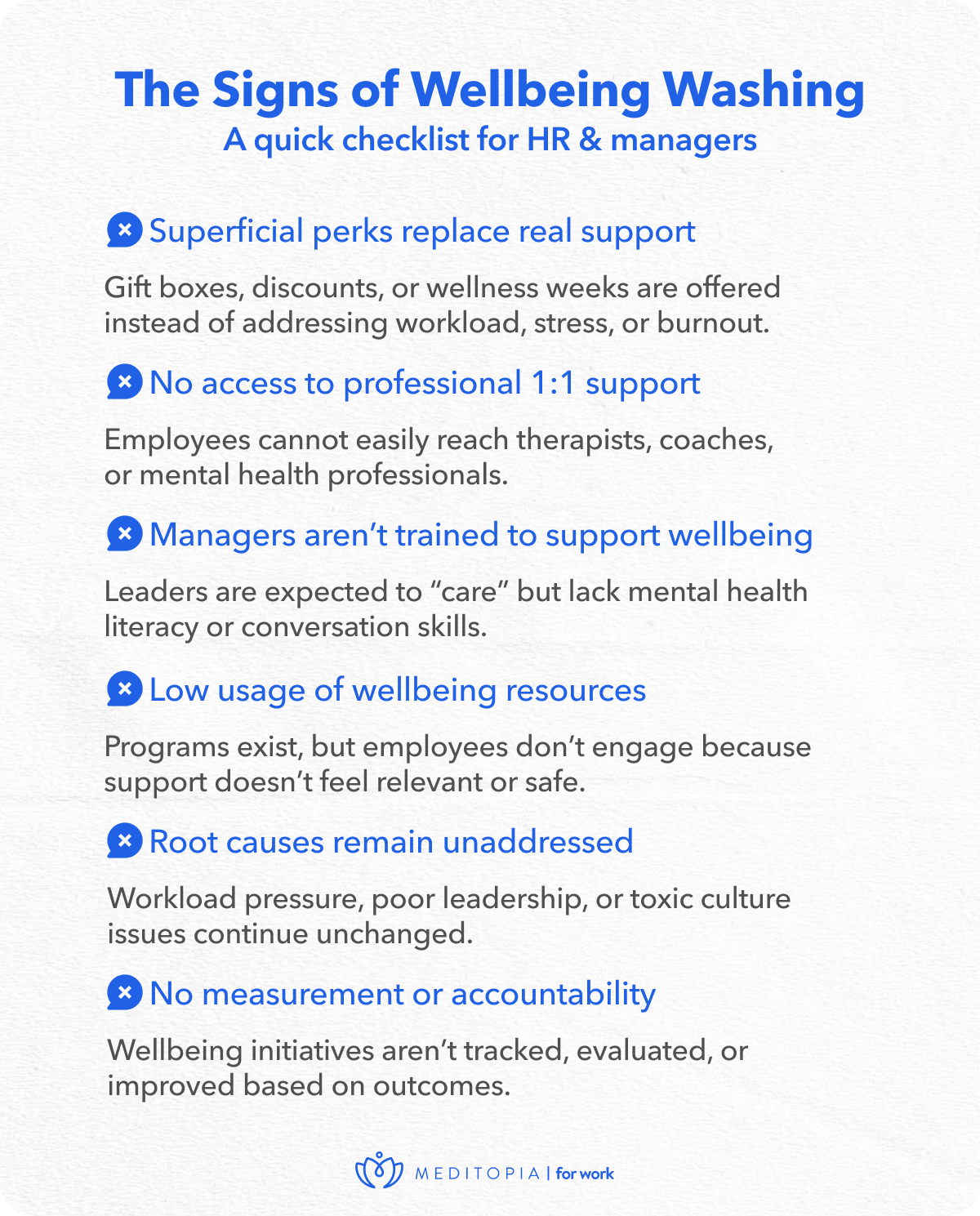
The Signs of Wellbeing Washing: Checklist
Wellbeing washing is rarely intentional, but it is often visible in patterns of decisions, not isolated actions. This checklist is designed as a practical diagnostic tool. It helps organisations assess whether their wellbeing initiatives are addressing root causes of stress and burnout, or simply signalling care without delivering meaningful support.
Why Wellbeing Washing Damages Trust & Culture
Superficial wellbeing efforts don’t just fall flat, they actively harm workplace trust and culture:
- It widens the gap between what the organisation says about wellbeing and what employees actually experience.
- Edelman research shows high stated trust in employers, but that trust erodes quickly when actions don’t match wellbeing messaging [1].
- It undermines the credibility of HR-led wellbeing initiatives.
- Gallup reports that only 21% of employees strongly agree their organisation cares about their overall wellbeing, which increases scepticism toward future initiatives [2].
- It increases cynicism and reduces participation in wellbeing resources.
- When support feels performative or symbolic, employees are less likely to use available tools, leading to low utilisation and wasted investment.
- It raises burnout risk because core drivers of stress remain unchanged.
- The American Psychological Association defines burnout as the result of chronic, unmanaged workplace stress, meaning perks alone do not address the problem [3].
- It creates measurable financial costs for employers.
- It weakens psychological safety.
- When wellbeing efforts feel insincere, employees are less likely to speak openly about stress, mental health challenges, or workload concerns.
- It damages employer brand credibility.
- External wellbeing messaging that doesn’t reflect internal reality is increasingly challenged by employee reviews and public platforms, increasing reputational risk.
What Authentic Employee Wellbeing Really Looks Like
Research consistently shows that effective wellbeing strategies focus on systemic wellbeing, not symbolic gestures. For HR and business leaders, the shift is clear: move from performative wellbeing and shallow wellness perks to meaningful wellbeing initiatives that are evidence-based, measurable, and sustained over time.
Real employee wellbeing:
- Prioritises psychological safety, ensuring employees feel secure bringing their whole selves to work.
- Targets root causes, (excess workload, poor job design, lack of autonomy) rather than surface-level stress indicators.
- Employs evidence-based solutions, continuously evaluated for impact.
Below are key elements of meaningful wellbeing with practical HR ties:
- Professional mental health access
- Meaningful wellbeing requires access to qualified professionals, not only self-help tools.
- This includes structured 1-1 support with psychologists or coaches, clear escalation pathways, and confidentiality employees trust.
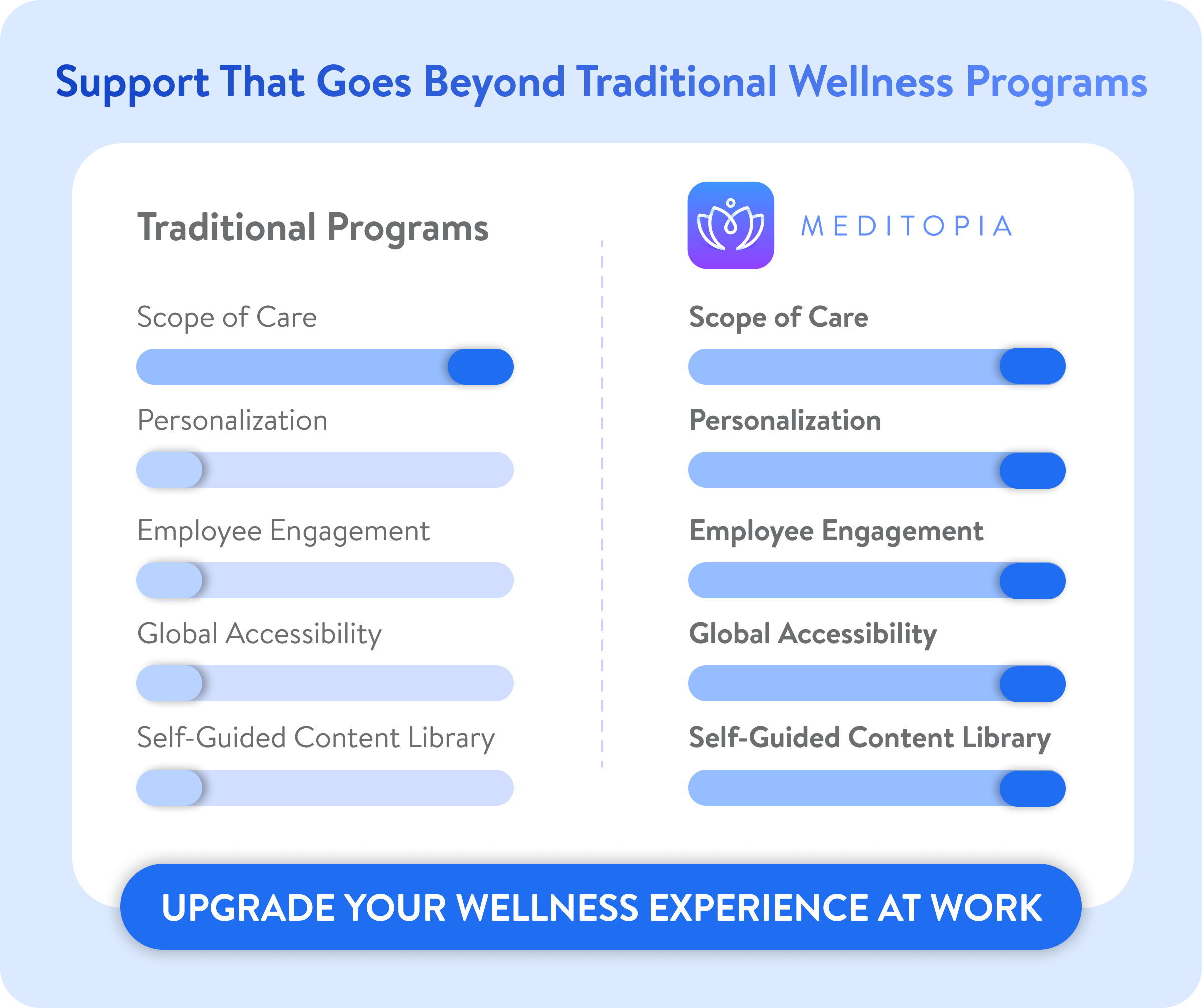
- Meditopia for Work offers your team 1-1 expert sessions, self-guided mindfulness content, acces to hundres of gym facilities in the city, AI wellbeing companions, corporate wellbeing challenges, and more!
- Evidence-based self-guided support
- Self-guided wellbeing tools are effective only when grounded in research and designed for real workplace stressors.
- Programs should use validated psychological approaches and be easy to integrate into daily routines, rather than relying on high motivation or long time commitments.
- Skills-based wellbeing training
- Training turns wellbeing from awareness into capability.
- Skills-based programmes help employees and managers develop practical abilities such as stress management, boundary setting, and recognising early burnout signals.
- Everyday psychological support
- Employees often need support in the moment, not only in scheduled sessions.
- Everyday psychological support tools like Meditopia provide low-barrier access to guidance for emotional regulation and reflection, reducing the risk that issues escalate.
- System-level changes
- Sustainable wellbeing depends on organisational design.
- This includes workload planning, role clarity, manager expectations, flexibility policies, and performance structures.
- Without system-level changes, even high-quality wellbeing resources struggle to gain trust or sustained use.
How To Avoid Wellbeing Washing (Practical HR Framework)
Use this action-oriented framework to ensure your strategy avoids superficiality and drives measurable impact:
- Assess employee needs: Use surveys, focus groups, and wellbeing data to understand core challenges.
- Build a strategy, not a list of perks: Define goals tied to employee needs and organisational outcomes.
- Provide professional support: Make high-quality mental health care accessible.
- Train managers in mental health literacy: Equip leaders with skills to foster psychological safety.
- Offer evidence-based, daily tools: Prioritise resources employees find meaningful and usable.
- Measure & adapt continuously: Use data, feedback, and outcome tracking to refine initiatives.
Examples of Wellbeing Washing vs Meaningful Wellbeing
We know sometimes good intentions can get misunderstood, and that mistakes can come out of nowhere. Take a look at this table to internalize what wellbeing washing looks like, and how meaningful support should be:
There have been real cases of wellbeing washing, too. Without meaning to critize, this is what has happened previously:
- Tech and knowledge-sector companies promoting wellbeing perks while maintaining extreme workloads:
- During and after the pandemic, multiple investigations highlighted companies that publicly promoted mental health days, meditation apps, or wellbeing campaigns while employees reported unsustainable workloads and burnout [5].
- Organisations offering wellness apps instead of structural change:
- Several analyses point out that employers increasingly rely on low-cost digital wellness tools while avoiding changes to workload, staffing, or job design [6].
- This pattern is frequently cited as symbolic or performative wellbeing.
- Employers marketing strong wellbeing cultures while employee reviews contradict them:
- Research using platforms like Glassdoor shows misalignment between employer wellbeing messaging and employee-reported stress, poor management support, or lack of psychological safety [7].
- This discrepancy is often highlighted as a reputational risk.
- Companies criticised for resilience messaging directed at employees rather than leaders:
- Some organisations have been criticised for promoting resilience and self-care to employees while failing to address leadership behaviour or systemic pressure [8].
- This approach has been described as shifting responsibility away from the organisation.
- Public sector and large employers facing scrutiny over wellbeing rhetoric vs realityIn the UK:
- Unions and employee surveys have repeatedly criticised employers that publicly commit to wellbeing while staff report high stress and limited access to meaningful support [9].