
Teams in nonprofit organizations often work with vulnerable groups, navigate unstable funding cycles, and manage high emotional load, all while striving to deliver maximum social impact. Employee Assistance Program (EAP) can be a strategic lever to protect staff wellbeing, sustain mission-driven work, and reduce avoidable turnover. Let's discover how.

Why EAPs Matter in the Non-Profit Sector
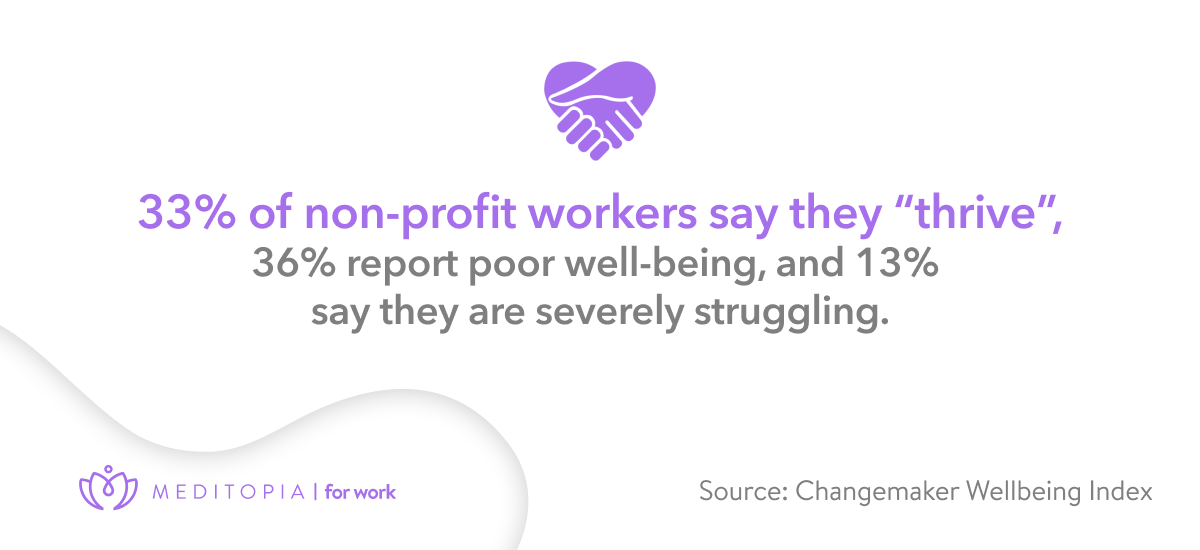
Non-profit employees often navigate emotionally demanding situations, community crises, and chronic workload strain. This combination increases the risk of secondary trauma, stress, and burnout, making structured support essential. These realities make structured mental-health support essential.
- Nearly 80% of nonprofit leaders report burnout and staffing shortages as their biggest challenge, showing the need for structured employee assistance and burnout support [1].
- Turnover in nonprofits averages 19%, far higher than the ~12% national average, making EAP for nonprofits essential for retention and workplace wellbeing.
- Non-profit staff have elevated exposure to secondary traumatic stress and compassion fatigue, increasing demand for mental health support and trauma-informed employee counselling [2].
- Chronic understaffing forces employees to take on multiple roles, amplifying stress and role overload, conditions where digital EAP solutions like Meditopia for Work provide scalable support.
- Emotional exhaustion in mission-driven roles reduces decision-making capacity and service quality, making early stress management for nonprofit employees critical.

EAP Use Cases in Non-Profit Organizations
Day to day, pressure in non-profits shows up in very specific ways: emergency campaigns, community crises, emotionally heavy cases or constant “doing more with less.” EAPs like Meditopia translate into concrete help in those moments, especially when delivered as flexible digital support alongside traditional services. Here are some examples:
Key Benefits of EAPs for Non-Profit Organizations
The value of EAP for nonprofits is not only emotional; it shows up in retention, performance and long-term sustainability. A large cross-sectional study of over 15,000 employees in Southeast Asia found that access to an EAP was significantly associated with better mental health, higher thriving and productivity, and lower turnover intention [3].
Another study showed that about 70% of employees using EAP counselling recovered or significantly improved after intervention, highlighting the impact of early support [4]. For non-profits, that translates into:
- Reduced burnout and turnover:
- When staff have access to counselling and mental health support, they are less likely to leave due to exhaustion or emotional overload, a major issue in a sector already reporting high burnout and retention challenges [5].
- Stronger workplace wellbeing and resilience:
- EAPs provide ongoing support for day-to-day stress, helping teams stay grounded during crises or peak periods and reinforcing overall workplace wellbeing.
- Better focus and service quality:
- By tackling stress and emotional overload early, EAPs help keep people focused, which is crucial when work directly affects communities and beneficiaries.
- More attractive employer brand:
- Research indicates that the vast majority of workers now actively look for employers that offer mental health support as part of their benefits [6].
- An EAP signals that the organization takes mental health in non-profits seriously.
- Structured, scalable support:
- Instead of ad-hoc solutions, non-profits get a consistent framework: employee assistance for crises, prevention, and ongoing self-care through a mix of counselling and digital EAP solutions.
Learn more about EAP utilization rates here.
How to Implement an EAP in a Non-Profit Organization
Non-profits often have limited budgets and time, so EAP implementation needs to be straightforward and realistic.
- Map needs and risks:
- Use surveys, informal check-ins and HR data to understand stressors, burnout risk and current support gaps.
- Pay attention to exposure to trauma, workload and role clarity.
- Choose the right employee assistance model:
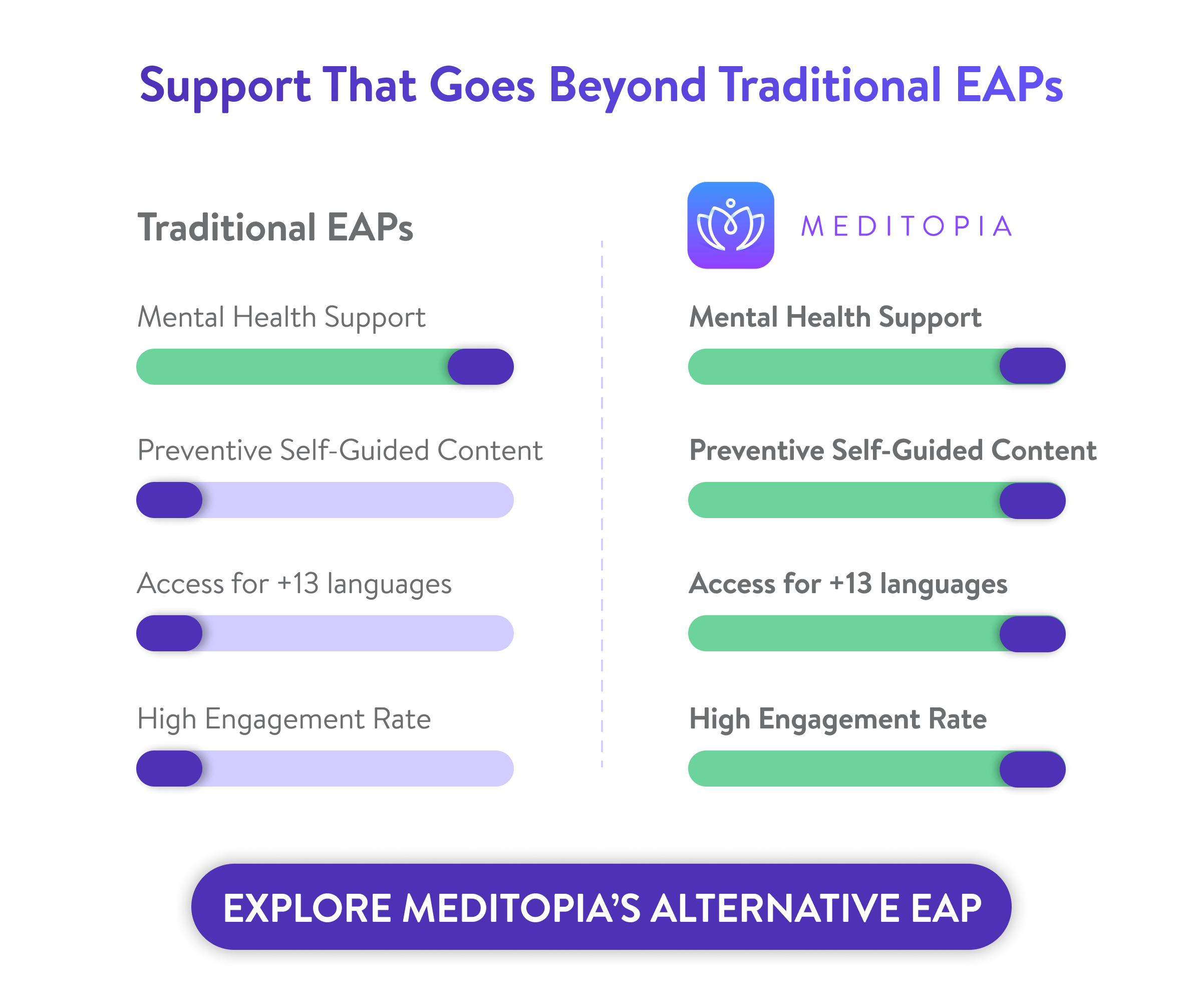
- Compare traditional providers with digital solutions like Meditopia, offering 24/7 content, online therapy, support in 14 languages, specialized workshops, access to gym studios, and more.
- Communicate clearly and build trust:
- Explain what the EAP covers, how confidentiality works, and how to access services.
- Many employees under-use wellbeing tools simply because they are unaware or unsure about privacy.
- Integrate with existing wellbeing efforts
- Align EAP communication with existing policies, psychosocial risk management and any internal employee engagement programs, so the service feels like part of a broader wellbeing strategy.
- Track, learn and adapt:
- Monitor usage, feedback and high-level indicators such as absenteeism or turnover intention.
- Studies show that EAPs focused on stress management can measurably reduce perceived stress; use this evidence to refine your program over time [7].
As always, you can count on Meditopia to take care of all these steps for you.
Why EAPs Matter for Non-Profits: Comparison with Other Industries
Every industry needs mental health support, but the stress profile is not the same. Non-profits sit closer to health and social care sectors in terms of emotional and ethical burdens and exposure to potentially traumatic events. Here's how employee assistance programs impact other industries: